 BINarrator
How to Reconcile Total Debt Across Financial Statements and Footnotes
Why the debt number in a company’s balance sheet may differ from its contractual borrowings—and how to explain the difference.
Debt & LiquidityFinancial Reconciliation
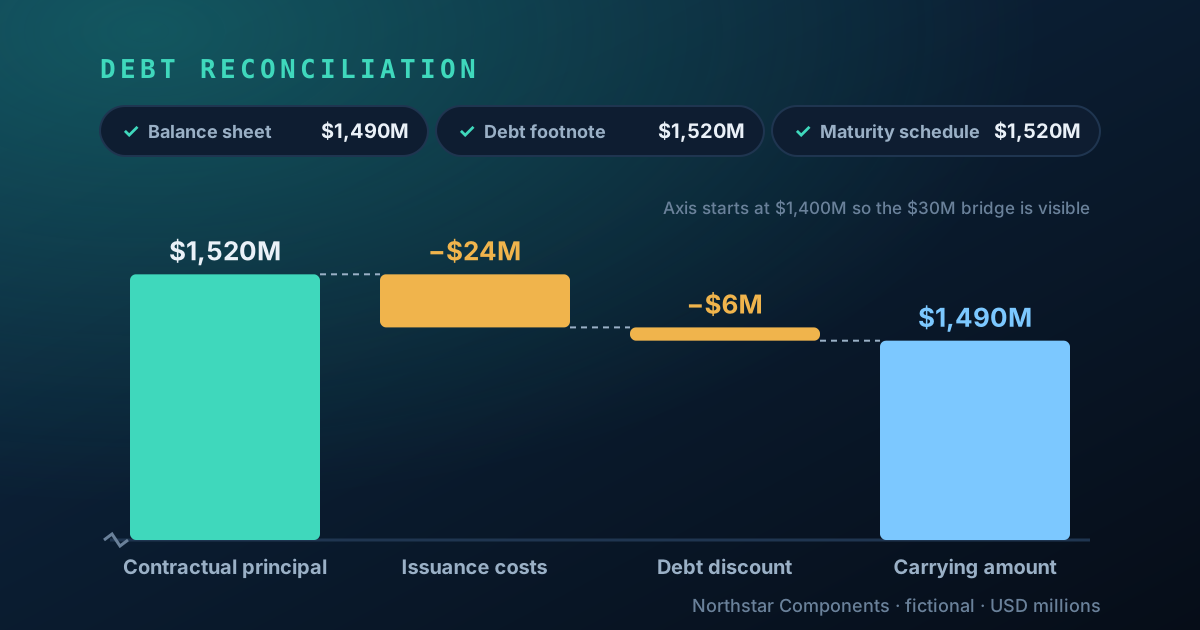
Imagine reviewing a company’s annual report and finding three different debt figures.
The balance sheet shows $1.49 billion. The debt footnote lists $1.52 billion of borrowings. The maturity schedule also totals $1.52 billion.
Which figure is correct?
The answer may be all three.
One of the most common challenges in corporate credit analysis is reconciling outstanding debt principal with the amount recorded under accounting rules.
The difference is not necessarily an error. It can result from debt discounts, issuance costs, current-versus-long-term classifications, and differences in the obligations included in each schedule.
For a credit analyst, understanding these differences is essential. A report that simply selects one figure without explaining its basis can misrepresent both the company’s financial position and its repayment obligations.
1. Understand What Each Debt Figure Represents
Three related concepts are particularly important.
Outstanding principal is the contractual amount owed to lenders or bondholders, subject to the specific instrument’s terms.
Carrying amount is the amount recognized on the balance sheet after applicable accounting adjustments, such as unamortized debt discounts and issuance costs.
Maturity amount is the principal scheduled to become payable in future periods, based on the scope and assumptions of the disclosed schedule.
These amounts often differ because they answer different questions.
For credit analysis, the objective is not to force them to be identical. It is to demonstrate how they reconcile.
2. Start with Every Borrowing Instrument
Consider Northstar Components, our fictional industrial manufacturer.
At December 31, 2025, the company has three categories of borrowings.
Amounts in USD millions.
| Borrowing instrument | Principal outstanding |
|---|---|
| Term loan | $600 |
| Senior notes | $800 |
| Revolving credit borrowings | $120 |
| Total contractual principal | $1,520 |
This becomes the starting point for the debt reconciliation.
The analyst should confirm each obligation using the debt footnotes and relevant financing agreements.
For each instrument, record the outstanding principal, interest-rate terms, maturity date, repayment structure, currency, collateral, guarantees, and any relevant covenant restrictions.
The record should also identify its source document and reporting date.
Without an instrument-level inventory, it is easy to overlook a borrowing or count an obligation twice.
3. Reconcile Principal to the Balance Sheet
Assume Northstar reports the following unamortized adjustments associated with its term loan and notes.
| Reconciliation item | Amount |
|---|---|
| Outstanding debt principal | $1,520M |
| Less: unamortized debt issuance costs | ($24M) |
| Less: unamortized debt discount | ($6M) |
| Total debt carrying amount | $1,490M |
The difference is $30 million.
That difference is not a repayment of principal. It reflects accounting adjustments to the carrying amount of the obligations.
Issuance costs may include qualifying underwriting, legal, and other costs directly associated with obtaining financing. Debt discounts can arise when a borrowing is initially recognized below its face amount.
Under applicable accounting treatment, these amounts generally affect the carrying value of the associated debt and are recognized through interest expense over time.
Revolving credit arrangement costs may receive different balance-sheet treatment from costs related to term loans or notes. The analyst must therefore verify the actual accounting policy rather than automatically deducting every financing fee from debt.
Why this matters
If the analyst reports $1.49 billion as the amount of contractual principal due, the figure may understate the actual principal repayment obligation.
If the analyst reports $1.52 billion as the GAAP carrying amount, the figure may overstate the amount recognized on the balance sheet.
A defensible analysis should retain both figures and clearly explain the bridge between them.
4. Separate Current and Long-Term Debt
Companies generally distinguish obligations classified as current liabilities from those classified as noncurrent liabilities.
Assume Northstar’s simplified balance-sheet presentation is:
| Classification | Carrying amount |
|---|---|
| Current portion of debt | $200M |
| Long-term debt, excluding current portion | $1,290M |
| Total debt carrying amount | $1,490M |
For this example, assume the unamortized adjustments relate to debt classified as noncurrent.
A frequent analytical error is adding the current portion to a total that already includes it.
For example, adding the $200 million current portion to the $1.49 billion total would incorrectly report $1.69 billion.
The correct approach is to determine whether a line item already represents total debt or only the noncurrent portion.
Current classification also deserves careful review when debt is close to maturity, has been refinanced, or becomes callable following a covenant breach.
5. Reconcile the Maturity Schedule
Northstar’s fictional contractual principal maturity schedule is:
| Year | Principal due |
|---|---|
| 2026 | $200M |
| 2027 | $120M |
| 2028 | $100M |
| 2029 | $600M |
| 2030 | $300M |
| 2031 and beyond | $200M |
| Total | $1,520M |
The maturity schedule totals $1.52 billion because it is based on principal repayments rather than the discounted accounting carrying amount.
The reconciliation is:
Contractual principal: $1,520M
Less accounting adjustments: $30M
Recognized debt carrying amount: $1,490M
The figures now tell a consistent story.
However, actual maturity schedules may exclude certain obligations, such as separately presented finance leases, or use assumptions about contractual repayment and maturity dates. Always check the schedule’s scope and footnotes before attempting to reconcile it.
6. Treat Revolving Credit Facilities Correctly
A revolving credit facility can create two distinct questions.
How much has the company already borrowed?
How much additional borrowing capacity might remain?
Northstar has a $450 million revolving credit commitment, $120 million of drawn borrowings, and $30 million of outstanding letters of credit.
Its simplified facility reconciliation is:
| Component | Amount |
|---|---|
| Revolving commitment | $450M |
| Outstanding borrowings | ($120M) |
| Letters of credit | ($30M) |
| Potential undrawn availability | $300M |
The $120 million already drawn is part of outstanding debt.
The $300 million potential availability is not an existing debt liability and is not cash.
It may provide future liquidity, but actual access depends on the facility’s legal terms, collateral requirements, borrowing-base provisions, covenants, and other conditions.
This distinction matters because treating unused borrowing capacity as outstanding debt inflates leverage, while treating it as unrestricted cash overstates liquidity.
7. Identify Obligations Outside the Main Debt Table
The main debt footnote may not capture every financially significant obligation.
Depending on the company’s business and reporting structure, analysts may also need to examine:
- Finance and operating lease liabilities
- Guarantees and letters of credit
- Receivables financing and securitization arrangements
- Equipment financing and other borrowing agreements
- Contingent payments and significant contractual commitments
These amounts should not automatically be added to conventional debt.
Instead, identify each obligation, describe its nature, and apply a clearly defined analytical treatment.
For example, an operating lease liability may be relevant to adjusted leverage, but adding it to debt without applying a comparable EBITDA or cash-flow definition can distort comparisons.
8. Create an Evidence Trail
Every reconciliation should make it possible for another analyst to reproduce the result.
A useful evidence register includes:
| Field | Example |
|---|---|
| Metric | Term loan principal |
| Value | $600M |
| Reporting date | December 31, 2025 |
| Source | Illustrative debt footnote |
| Classification | Reported principal |
| Adjustment | Related issuance costs where applicable |
| Output | Debt inventory and reconciliation |
The supporting process should answer four questions:
- Where did the amount come from?
- What does the amount represent?
- Which adjustments were applied?
- Does the result reconcile to related disclosures?
If a difference remains unexplained, flag it for review rather than introducing a balancing number without evidence.
9. Common Mistakes That Can Distort Credit Analysis
Confusing principal with carrying amount: Contractual debt may be greater than the net amount recorded on the balance sheet.
Double-counting current debt: Adding current maturities to a total that already includes them can overstate liabilities.
Counting undrawn credit as debt: Available borrowing capacity is not an outstanding obligation.
Ignoring reporting dates: Comparing year-end debt with a maturity schedule updated in a later quarter can create a false discrepancy.
Mixing lease and borrowing definitions: Different analytical frameworks may treat leases differently.
Assuming a missing number is zero: A figure not disclosed cannot automatically be treated as nonexistent.
These mistakes can materially affect leverage calculations, liquidity assessments, and credit conclusions.
Final Thoughts
Reconciling debt is more than an accounting exercise. It is an essential part of understanding what a company owes, how those obligations are recorded, and when repayment is required.
A trustworthy credit report should preserve the distinction between contractual principal, balance-sheet carrying amount, and scheduled maturities.
It should also make every material adjustment visible.
At BINarrator.ai, we believe credit intelligence should remain open to scrutiny. Financial figures should be traceable to their sources, calculated metrics should disclose their inputs, and unexplained differences should be treated as evidence gaps requiring investigation.
Further reading: SEC — How to Read a 10-K · SEC — Search Company Filings
Northstar Components is fictional, and all figures are illustrative. Accounting treatment depends on the specific financial instruments, contractual terms, and applicable reporting standards. Educational content only.
Want to see how evidence-backed financial analysis is presented?
Explore sample report