 BINarrator
Covenant headroom: the metric that warns you early
Most companies tell you they complied with their loan rules. What matters is how close they came to breaking them.
Debt & LiquidityFinancial Covenants
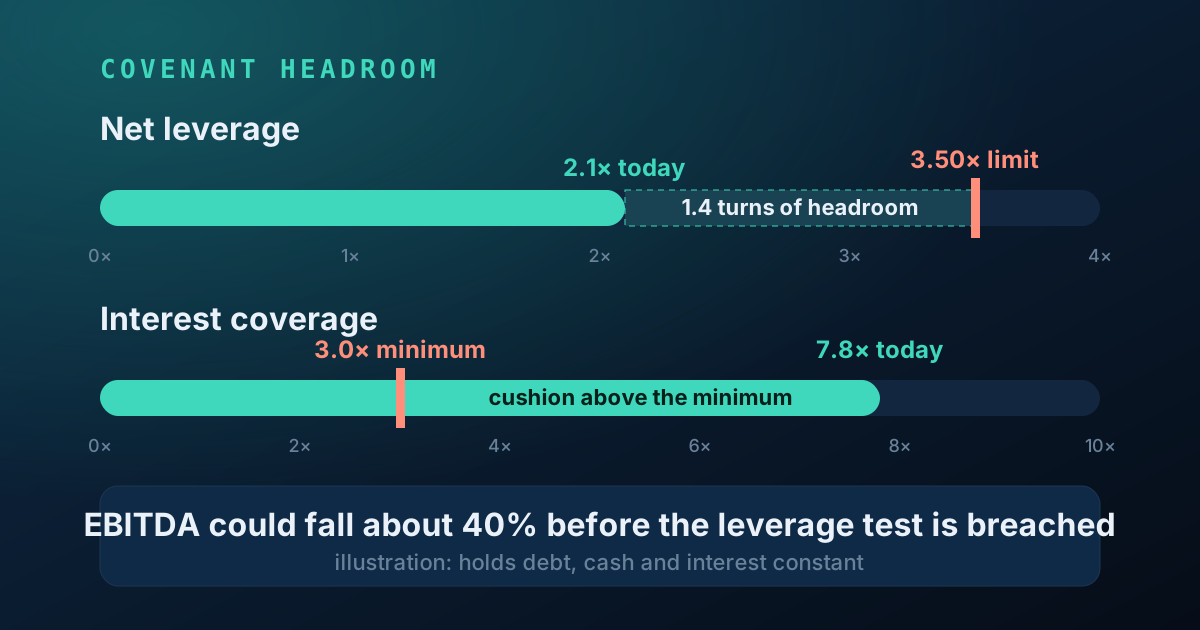
When a company borrows, the lender usually writes a few financial rules into the loan agreement. These are covenants. If the company breaks one, the lender can demand changes, charge more, or in the worst case call the loan. So the distance between where a company stands and where a rule bites, its headroom, is one of the clearest early warnings in credit analysis.
The two tests you see most often
A maximum net leverage test caps net debt as a multiple of EBITDA. A minimum interest coverage test requires EBITDA to cover interest expense a set number of times. Both are normally tested every quarter.
| Net leverage | 2.1× | limit 3.50× tested quarterly, so headroom is 1.4 turns |
| Interest coverage | 7.8× | minimum 3.00×; EBITDA $1.48B against interest of $0.19B |
| Company statement | Complied | with all covenants at December 31, 2025 |
Turn headroom into a cushion
A turn count is hard to feel, so translate it. Holding net debt at $3.1 billion, Meridian would reach the 3.5 times limit if EBITDA fell to about $0.89 billion. That is a drop of roughly 40 percent from $1.48 billion. The interest test is further away: three times $0.19 billion is $0.57 billion. So leverage is the test to watch.
Treat this as an illustration. It assumes debt, cash and interest stay put, and in a real downturn they rarely do. Its job is to show which rule bites first and how much room there is.
Why "complied with all covenants" is not enough
The company statement is a yes or no. A company that passed with a large cushion and one that passed by a hair give the same answer. Headroom turns the yes into a distance, and the distance is what changes first when conditions worsen.
What shrinks headroom
- Falling earnings. Lower EBITDA hits the leverage test and the coverage test together.
- New borrowing. Meridian has announced a $310 million cash acquisition. If it were funded entirely with new debt, net leverage would rise from about 2.1 to about 2.3 times. Events like this are why a report keeps watching after it is published.
- Definitions. The agreement defines EBITDA and debt in its own way, with add-backs and carve-outs. A simple calculation is a good indicator, but the agreement text decides the real test.
Showing what is not known
The sample company's credit agreement names a loan margin, but the pricing grid that sets the rate is not in the document. A report that filled the number from a guess would look more complete and be less honest, so BINarrator lists it as an open gap instead.
Headroom figures are indicators, not a credit rating or a forecast. Meridian Industrial Holdings is an invented company.
See how every figure in a report links to its source.
Try the sample report