 BINarrator
How to Build a Credit Brief from an SEC Filing
A step-by-step framework for transforming annual disclosures into a structured, evidence-backed corporate credit assessment.
SEC Filings & Risk EventsCredit Analysis
A corporate annual report may contain hundreds of pages of financial statements, accounting policies, risk disclosures, debt agreements, and management commentary.
A credit analyst must turn that information into something much more concise: a clear assessment of the company’s financial strength, repayment capacity, and principal credit risks.
This is where a well-structured credit brief becomes valuable.
But the purpose of a credit brief is not simply to summarize an annual report.
It is to answer a more demanding question:
What does the available evidence tell us about the company’s ability and willingness to meet its financial obligations?
A good credit brief should communicate the conclusion, show the supporting financial evidence, distinguish assumptions from reported facts, and identify uncertainties that require further investigation.
1. Define the Purpose Before Collecting Information
The first step is to understand the decision the credit brief will support.
The requirements may differ depending on whether the reader is:
- A commercial lender evaluating a borrower
- A portfolio manager reviewing an existing investment
- A supplier assessing counterparty exposure
- A corporate development professional reviewing an acquisition target
- A credit committee evaluating risk limits or financial conditions
Regardless of the use case, the report should establish the company being evaluated, the reporting date, the intended decision, and the scope of the analysis.
An initial company review and a formal credit approval are not the same thing. The required depth of financial verification, covenant analysis, and documentation may differ substantially.
2. Identify the Authoritative Source Documents
For U.S.-listed companies, the Form 10-K provides an important starting point.
However, a current credit brief should generally incorporate additional relevant disclosures.
| Document | Primary analytical purpose |
|---|---|
| Form 10-K | Annual operating, financial, and risk disclosures |
| Form 10-Q | Interim financial results and material updates |
| Form 8-K | Reportable corporate events and developments |
| Credit agreements and indentures | Debt terms, covenants, guarantees, and security |
| Financial statement notes | Accounting policies, debt details, commitments, and contingencies |
| Relevant company announcements | Additional context, with appropriate attention to filing status and evidence quality |
The analyst should record each document’s reporting period, publication date, and applicable version.
For example, a December 31, 2025 balance sheet should not be presented as a September 30, 2026 balance sheet merely because the report is being prepared in November 2026.
Period integrity is essential.
3. Build a Standardized Financial Profile
Once source documents are collected, extract the financial measures required for the credit assessment.
These generally include profitability, leverage, liquidity, cash flow, and debt obligations.
Using our fictional Northstar Components example:
FY2025, USD millions unless otherwise indicated.
| Financial metric | Amount |
|---|---|
| Revenue | $2,400 |
| Operating income | $255 |
| EBITDA proxy | $360 |
| Operating cash flow | $250 |
| Capital expenditure | $150 |
| Free cash flow | $100 |
| Outstanding debt principal | $1,520 |
| Cash and cash equivalents | $260 |
| Simplified net debt | $1,260 |
| Simplified net leverage | 3.50× |
| EBITDA proxy / interest expense | 4.50× |
Each metric needs a defined calculation or source.
For example:
Simplified net leverage = (Debt principal − Cash) ÷ EBITDA proxy
($1,520M − $260M) ÷ $360M = 3.50×
This is an illustrative analytical ratio, not a contractual covenant calculation.
An actual credit brief should disclose the numerator and denominator definitions, source periods, and any adjustments.
Financial comparability should not be assumed when two companies use different adjusted EBITDA definitions or when balance-sheet and earnings periods do not align.
4. Analyze the Debt and Liquidity Position
A credit brief should address the company’s contractual repayment obligations and the resources available to meet them.
For Northstar, the analysis would identify:
Total outstanding principal: $1.52 billion.
Cash and cash equivalents: $260 million.
Potential unused revolving capacity: $300 million, subject to agreement conditions.
Major debt maturity: $600 million in 2029.
Historical FY2025 free cash flow: $100 million.
These figures suggest several questions.
Is cash available for debt service after operating needs?
Could the company generate sufficient cash before its largest maturities?
Is the revolving facility available under applicable conditions?
Would refinancing increase future interest expense?
Could a deterioration in earnings create covenant pressure?
A useful credit brief does not assume answers that the source documents do not establish.
5. Evaluate Qualitative Credit Risks
Financial ratios provide useful indicators, but creditworthiness also depends on business resilience.
The qualitative assessment should examine the factors most relevant to the company’s industry.
For an industrial manufacturer, these may include customer concentration, economic cyclicality, commodity exposure, manufacturing costs, supply-chain dependence, competition, and capital expenditure requirements.
The analyst should distinguish between:
Reported facts: Information directly supported by filings or other reliable source documents.
Analytical interpretations: Conclusions derived from documented evidence.
Scenarios: Possible future outcomes based on explicit assumptions.
Information gaps: Important facts that have not been established.
For example, a company disclosing that a major customer represents 25% of revenue provides a measurable concentration exposure.
However, the analyst should not automatically conclude that the customer relationship is deteriorating unless additional evidence supports that claim.
6. Prepare the Executive Credit Summary
Senior decision-makers often need a concise overview before reviewing the supporting detail.
A useful executive summary should present the company’s operating position, financial condition, key strengths, material risks, and unresolved questions.
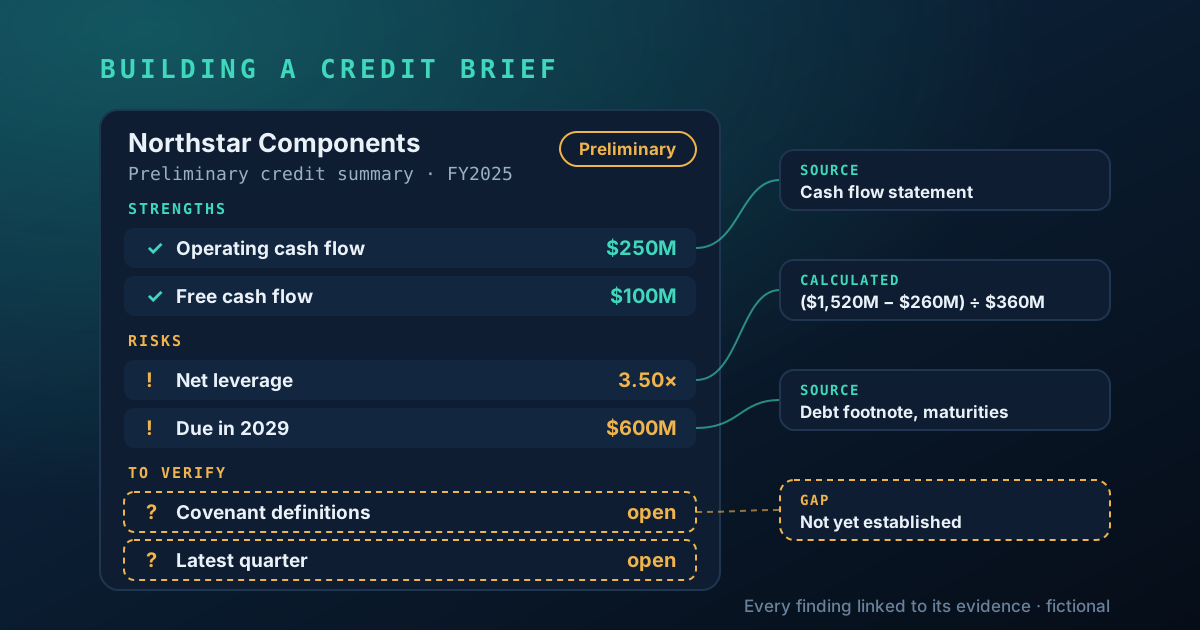
Example: Northstar Components — Preliminary Credit Summary
Fictional illustration based on FY2025 information.
Company overview
Northstar Components is an illustrative industrial manufacturer with $2.4 billion in annual revenue.
Operating performance
The company generated $255 million in operating income and $250 million in operating cash flow during FY2025.
Debt and leverage
Outstanding debt principal totaled $1.52 billion. Simplified net leverage was 3.50× using the stated analytical definitions.
Liquidity
The company held $260 million in cash and reported a revolving facility with potential undrawn availability of $300 million, subject to contractual conditions.
Primary financial risks
The most significant identified concerns are leverage, limited historical free cash flow relative to outstanding principal, and a $600 million maturity concentration in 2029.
Potential credit strengths
Positive operating cash generation, positive free cash flow, and an existing cash balance provide some financial flexibility.
Outstanding information requirements
Current quarterly financial results, actual cash accessibility, covenant definitions and compliance, borrowing availability, and subsequent financing developments require verification.
Assessment status: Preliminary — further verification required.
No credit approval, external rating, or lending recommendation is implied.
This example demonstrates how an executive summary can communicate meaningful conclusions without overstating the available evidence.
7. Develop the Detailed Credit Brief
The detailed brief should support the executive summary with source-linked analysis.
I recommend the following structure:
| Section | Key content |
|---|---|
| 1. Executive credit assessment | Overall findings, strengths, risks, and outstanding questions |
| 2. Company and business overview | Operations, segments, markets, and business dependencies |
| 3. Financial performance | Revenue, profitability, margins, and financial trends |
| 4. Cash flow analysis | Operating cash flow, capital spending, and cash conversion |
| 5. Debt and capital structure | Borrowings, instruments, guarantees, collateral, and accounting reconciliations |
| 6. Liquidity and refinancing | Cash, credit facilities, maturities, and funding considerations |
| 7. Covenants and restrictions | Contractual terms, compliance, headroom, and unresolved disclosures |
| 8. Material developments | Relevant events after the annual reporting date |
| 9. Credit strengths and risks | Evidence-supported positive and negative factors |
| 10. Conclusion and information gaps | Analytical judgment, limitations, and next review actions |
The structure should be adjusted for the business, transaction, and intended audience.
A financial institution may require additional sections covering internal credit ratings, stress testing, collateral valuation, regulatory considerations, or approval conditions.
8. Preserve the Evidence Behind Every Conclusion
Consider this statement:
“Northstar faces material refinancing exposure in 2029.”
A reliable credit brief should show why.
The supporting evidence would include:
- Outstanding debt principal of $1.52 billion
- Contractual principal maturities of $600 million in 2029
- Annual FY2025 free cash flow of $100 million
- The relevant debt agreements and maturity disclosures
- Any subsequently disclosed refinancing transactions
The statement is an analytical conclusion. The underlying numbers and documents are its evidence.
A different conclusion may be appropriate if subsequent reports show that the company has refinanced the debt, raised additional capital, or materially improved cash generation.
That is why credit findings need dates, source references, and clear distinction between fact and interpretation.
9. Validate the Brief Before Publication
A completed draft should undergo independent quality checks before being used in a consequential decision.
A practical validation checklist includes:
- Are all major reported figures supported by source documents?
- Do units, currencies, signs, and financial periods match?
- Do calculated metrics reproduce correctly from their stated inputs?
- Does contractual debt reconcile to its accounting carrying amount?
- Does the maturity schedule reconcile to the obligations included within its scope?
- Are liquidity limitations and covenant terms represented accurately?
- Are relevant subsequent events reflected without rewriting historical figures?
- Do the executive summary and detailed brief agree?
- Are material claims supported by the cited evidence?
- Are missing disclosures and unresolved discrepancies explicitly identified?
A material discrepancy should trigger investigation rather than silent correction.
Changes should preserve their supporting evidence and, where required, be subject to appropriate human review and approval.
10. What Makes a Credit Brief Decision-Ready?
A polished report is not necessarily a reliable report.
A credit brief becomes more useful when its material conclusions are transparent, its financial calculations are reproducible, and its limitations are clear to the reader.
Four characteristics are particularly important.
Accuracy: Reported figures agree with authoritative source information.
Consistency: Financial definitions, reporting periods, and conclusions align throughout the report.
Traceability: Readers can inspect the evidence supporting each important claim.
Accountability: Material corrections and approval decisions are governed by a defined review process.
These attributes support professional judgment; they do not eliminate the need for it.
Final Thoughts
Building a credible credit brief requires more than summarizing an annual report.
It requires collecting authoritative evidence, understanding the business, reconciling financial obligations, analyzing repayment capacity, evaluating risks, and validating the resulting conclusions.
Artificial intelligence can help organize and analyze large volumes of information. But automation does not remove the need for clear definitions, independent checks, and human accountability.
At BINarrator.ai, our vision is to make enterprise credit intelligence transparent and verifiable, helping professionals understand not only what a report concludes, but also the evidence behind that conclusion.
Further reading: SEC — How to Read a 10-K/10-Q · SEC — EDGAR Filings
Northstar Components is fictional, and all figures are illustrative. Actual credit decisions require current disclosures, appropriate financial analysis, independent judgment, and any applicable institutional review and approval.
Explore how BINarrator.ai presents evidence-backed credit intelligence.
Explore sample report