 BINarrator
Every metric needs a receipt
A number with no source is an opinion. Why we label what was reported, what was calculated, and what is missing.
AI Verification & TrustSource Traceability
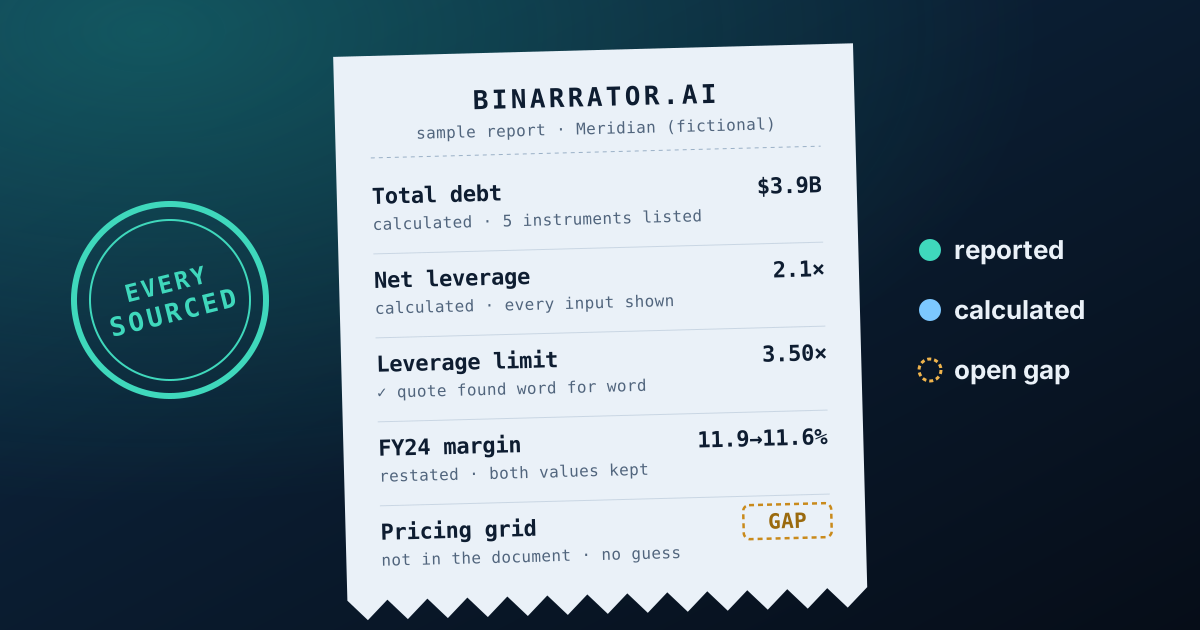
Most bad decisions made from financial data do not come from arithmetic mistakes. They come from numbers nobody can trace: a figure copied from last year, a ratio built on an input no one remembers choosing, a blank cell that someone read as zero. A metric earns trust the same way an expense does, with a receipt.
Three kinds of numbers
Reported numbers are stated in the company's own documents, and the exact words are kept beside them. Calculated numbers are worked out from reported ones, and the inputs are listed. Missing numbers are things the documents do not say, and they are shown as gaps. Mixing the three together is where trust is lost.
Numbers get restated
In the sample report, the FY2025 report restates the FY2024 operating margin from 11.9% to 11.6% after a change in how tooling costs are accounted for. Anyone who pulled the FY2024 figure a year ago is holding a number the company no longer stands behind. A report that shows both values, and the report each one came from, lets you see the change instead of discovering it later.
Risk hides in the text
Some of the most important metrics never appear in a table. Customer concentration is a good example. The sample company says Ardent Defense is 27 percent of sales and Skyline Air is 14 percent. Add them and two customers account for 41 percent of revenue. That is a calculated figure resting on two quotes, and losing either customer would change the picture.
A gap is information
The sample report notes that one of its investments, Solano Drives, is private, so its financial results are not available. An empty cell invites a guess. An explicit gap tells you the question was asked and the documents were silent, which is a fact you can plan around.
The checks behind the label
- Software searches the stored document for each quote, word for word. A claim with no match is thrown away.
- Figures are compared with the document's structured data, and the arithmetic is run again.
- Every source link must open.
- A named reviewer reads the summary beside its quote and approves it. Covenants and guarantees always need a person.
The result is a report you can argue with, which is the point. When you can see where each number came from, you can decide how much weight it deserves.
Meridian Industrial Holdings is an invented company used to show every kind of fact a report holds.
See how every figure in a report links to its source.
Try the sample report