
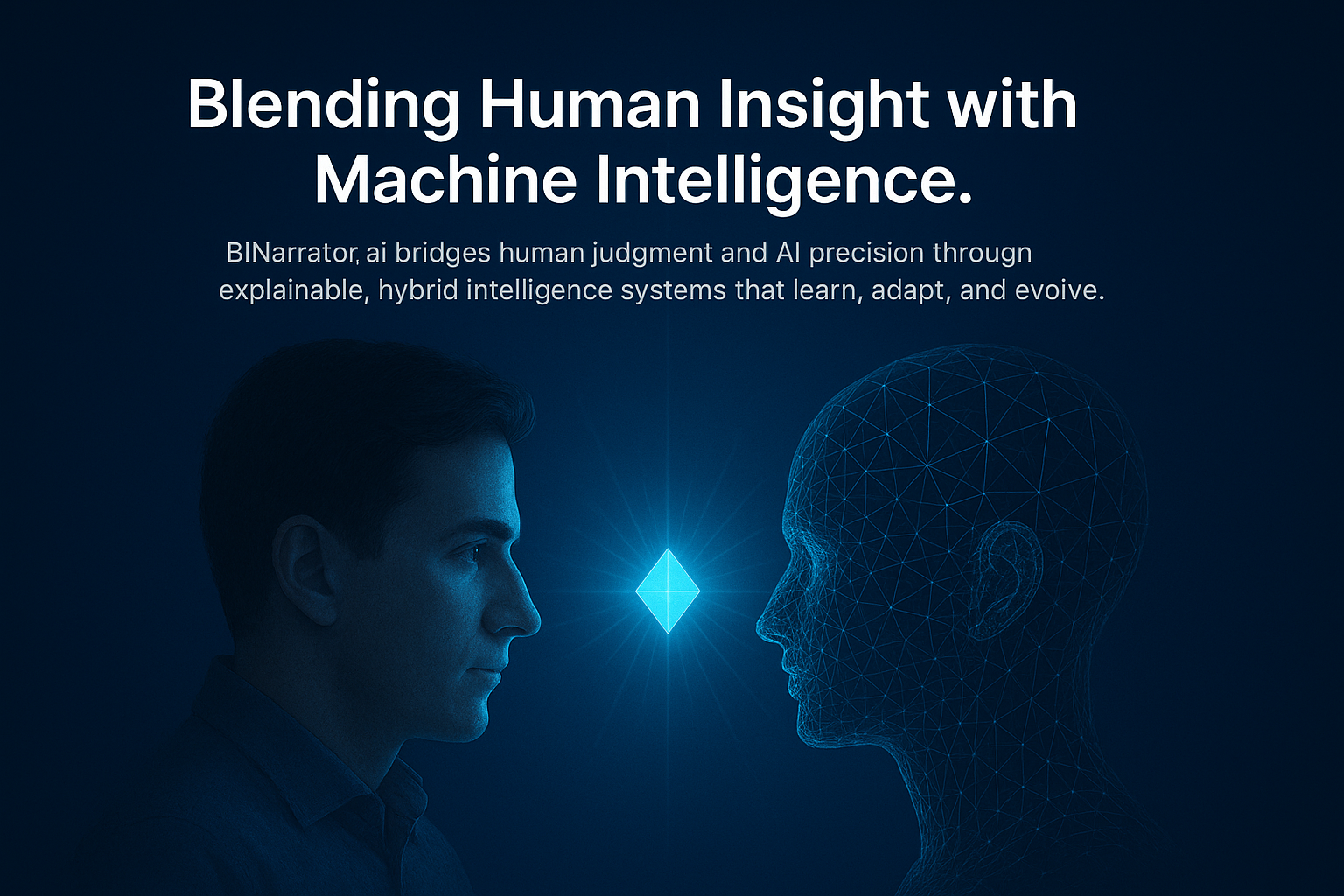
Introduction: The Human Factor in an Automated World
As artificial intelligence accelerates across industries, a new challenge emerges: how do we ensure machines enhance human judgment rather than replace it?
The answer lies in Hybrid Decision Intelligence (HDI) — an emerging paradigm that fuses machine precision with human ethics and contextual reasoning.
At BINarrator.ai, we view HDI as the evolution of enterprise decision-making — not just smarter automation, but governed collaboration between humans and AI systems designed to optimize outcomes without sacrificing fairness or accountability.
Why Pure Automation Falls Short
Traditional automation was built for efficiency — repeatable processes, consistent logic, and speed.
But in critical domains such as credit, healthcare, and operations, decisions often rely on context, emotion, and experience — areas where algorithms alone cannot reason ethically.
AI models excel at pattern detection but lack moral inference.
Without human oversight, even accurate systems can produce biased, opaque, or unethical outcomes — eroding trust, compliance, and brand integrity.
To build true intelligence, enterprises must evolve from automated to augmented decision systems.
The Hybrid Decision Intelligence Framework
BINarrator.ai’s HDI model brings together data science, governance, and human cognition in a unified decision loop — ensuring that every automated insight remains explainable, traceable, and justifiable.
Our framework includes four foundational layers:
- Explainable AI (XAI) Models
Every model deployed within BINarrator.ai includes interpretability logic — from SHAP and LIME to causal modeling — enabling users to understand why and how decisions are made. - Human-in-the-Loop Feedback
We embed structured checkpoints where human experts validate, correct, and refine model outputs. This ensures systems continuously learn from domain expertise rather than operate in isolation. - Governed Decision Pipelines
Every step — data collection, model inference, and human override — is captured in a transparent audit trail. This satisfies regulatory expectations under frameworks like the EU AI Act and NIST AI RMF. - Adaptive Learning Engine
The system learns not just from data, but from decisions themselves — creating a feedback loop that enhances accuracy while maintaining ethical alignment.
Together, these layers create a symbiotic intelligence — where humans provide empathy and accountability, and AI contributes scalability and insight.
Real-World Impact Across Industries
- Financial Services: Human–AI teams evaluate loan decisions with explainable risk models, reducing bias while improving turnaround times.
- Healthcare: AI predicts patient outcomes, while physicians apply contextual judgment, improving both safety and trust.
- Operations & Manufacturing: AI-driven forecasts paired with human supervision ensure optimized supply chains without compromising ethics.
In each scenario, HDI delivers the same outcome — decisions that are fast, fair, and fully accountable.
The ROI of Collaboration
Organizations adopting Hybrid Decision Intelligence achieve:
- Up to 40% improvement in decision accuracy through real-time human validation.
- 25% faster deployment of AI systems, thanks to trust-based adoption.
- Greater regulatory confidence, as every automated process is explainable by design.
By turning oversight into an operational asset, HDI transforms AI from a compliance challenge into a strategic differentiator.
Conclusion: The Next Evolution of Enterprise Intelligence
The future of AI isn’t artificial — it’s augmented.
Hybrid Decision Intelligence represents the next leap in responsible transformation — one where governance, empathy, and automation coexist in harmony.
BINarrator.ai is pioneering this shift by designing systems that think fast but act responsibly — ensuring that every insight is not just intelligent, but human-aligned, fair, and transparent.