
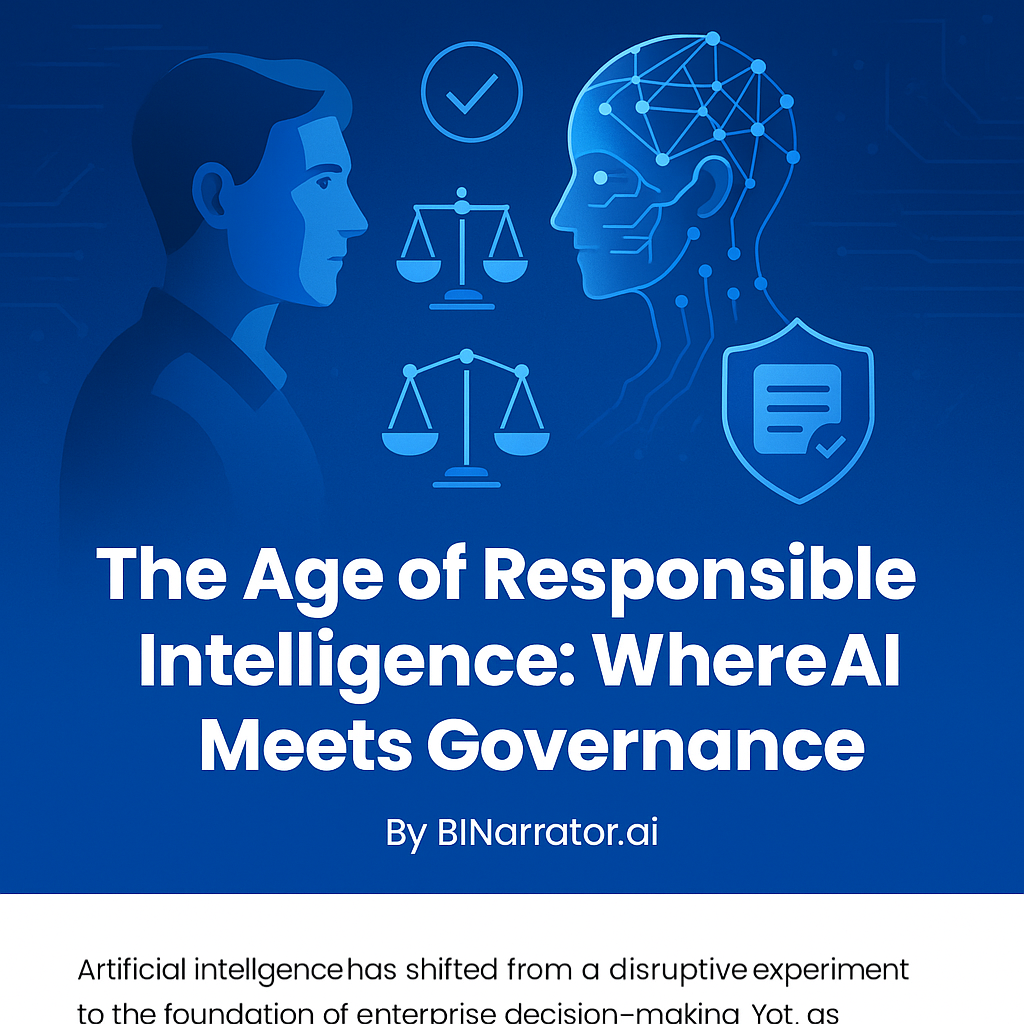
Introduction: AI’s New Imperative — Accountability
Artificial intelligence has shifted from a disruptive experiment to the foundation of enterprise decision-making. Yet, as algorithms become more powerful, the world is demanding more than accuracy — it demands accountability.
Enter the era of Responsible Intelligence: where data governance, transparency, and explainability become the currency of trust.
At BINarrator.ai, we believe AI should not only predict outcomes but also justify them. In this new landscape, intelligence without governance is risk — and governance without intelligence is stagnation.
From Automation to Understanding
Traditional AI focused on automation — replacing repetitive human tasks with statistical precision.
Responsible Intelligence takes the next step: augmenting human understanding.
By embedding explainable AI methods (SHAP, LIME, TCAV) into governed data ecosystems, organizations move beyond blind automation to auditable, ethical, and human-aligned decision systems.
It’s not about faster predictions — it’s about trustworthy foresight that executives can explain to boards, regulators, and customers alike.
Governance as a Growth Strategy
For years, governance was seen as a control function — a necessary friction. BINarrator.ai turns it into a growth enabler.
Our Responsible Intelligence framework merges data lineage, compliance automation, and bias detection into one transparent pipeline — giving leaders instant visibility into how data flows, transforms, and influences outcomes.
This transparency doesn’t slow progress; it accelerates it.
Enterprises with governed AI outperform peers with 25–40% faster deployment cycles and 30% fewer model validation bottlenecks.
When trust is engineered into your system, every insight becomes actionable.
The Ethical Architecture Behind Intelligence
True intelligence starts at the architecture level.
BINarrator.ai’s ethical design principles rest on four pillars introduced by our founder during his IEEE Tech Talk on Responsible AI in Credit Risk:
-
Inclusive Data – Ensuring diversity in every dataset to minimize systemic bias.
-
Explainable Models – Making every prediction interpretable and defensible.
-
Fair Governance – Embedding fairness audits and compliance checkpoints in real time.
-
Human Oversight – Keeping people in control of consequential decisions.
This architecture ensures that every AI-powered action is traceable, fair, and accountable, transforming ethics from philosophy into measurable infrastructure.
Bridging Industries, Scaling Trust
Responsible Intelligence isn’t limited to finance or credit systems — it’s an industry-agnostic movement.
From healthcare to manufacturing, energy to logistics, organizations are re-engineering their intelligence pipelines around the same principle: transparency builds trust; trust drives growth.
With BINarrator.ai, enterprises achieve that balance — operating at the speed of AI while maintaining the reliability of human judgment.
The ROI of Responsibility
Ethics and profitability are no longer opposites.
Companies that operationalize Responsible Intelligence see tangible returns:
-
Lower risk exposure through automated compliance and traceable decisions.
-
Faster approvals from regulators and auditors.
-
Higher customer retention driven by transparent communication and fair outcomes.
-
Increased investor confidence as ESG and AI governance converge.
In short: Responsible Intelligence = Sustainable ROI.
Conclusion: Intelligence With Integrity
The future of AI belongs to those who design it responsibly.
At BINarrator.ai, we help enterprises transition from opaque automation to transparent intelligence — connecting governance, performance, and ethics into one continuous system of trust.
Because in today’s data economy, responsibility isn’t a compliance checkbox — it’s your greatest competitive advantage.